
In this article we will discuss a very promising compound for androgenic alopecia for men and women that only works locally on the hair follicles and doesn’t cause any systematic side effects like sexual dysfunction.
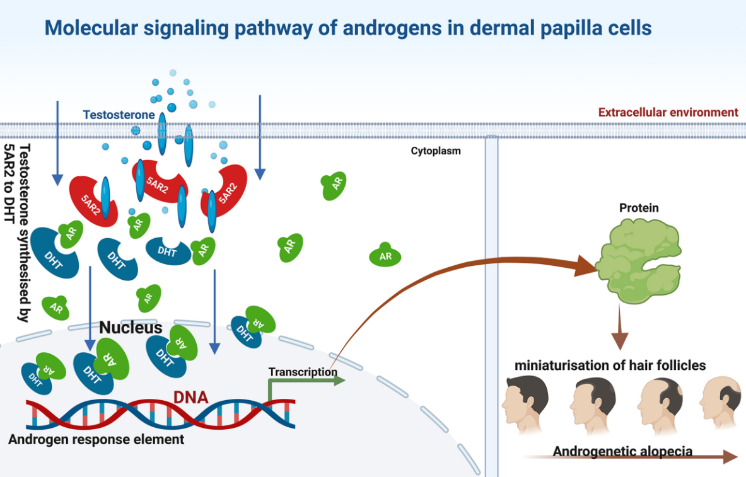
Ntschingila et al 2023
Before we discuss it, we must understand the mechanism behind androgenic alopecia: Men and women have androgens in their body in different concentrations. [1] [2] The most known one is testosterone, which is then converted to a much stronger androgen called DHT (dihydrotestosterone) by the enzyme type II 5α-reductase. These hormones, especially DHT, bind to the androgen receptor, which causes the expression of specific proteins that thin and miniaturize the hair follicles. This stops the growth of the hair. [3] After prolonged exposure to high concentrations of androgens, the hair follicles die and scar tissue forms. [4]
The most known treatment for androgenic alopecia is finasteride and dutasteride, which inhibit the type II 5α-reductase and reduce the conversion of testosterone to DHT. Without enough DHT, androgenic alopecia can be stopped in most people. But some people experience sexual side effects, depression, and lowered fertility. [5] or are too young to start finasteride and dutasteride, because they can alter the development of male characteristics like penile growth and secondary sexual features in puberty. [6]
Another way to stop androgenic alopecia is to block the binding of androgens to the androgen receptor in the scalp with so-called antiandrogens. Some antiandrogens get absorbed systemically and inhibit androgens in the whole body, which causes side effects of hypogonadism like gynecomastia, erectile dysfunction, muscle loss, and depression. [7] Thus, there is a need for an antiandrogen that is only effective locally on the scalp.
A compound that doesn’t get absorbed systemically is called topilutamide or fluridil. This compound is hydrophobic, so it is hard to be absorbed into the bloodstream. And even if it gets absorbed, it would be broken down rapidly, because contact with water causes the active component to be hydrolyzed: A study in 2002 showed that no drug or its byproducts could be found in the blood serum of people using fluridil for 9 months. In addition, none of the participants experienced sexual side effects. [8]
Finasteride doesn’t inhibit the DHT production completely, thus the androgenic signaling of DHT isn’t completely suppressed. [9]
The inclusion of a topical anti-androgen such as Topilutamide can reduce the binding of androgens to hair follicles, yielding positive effects on hair growth. Moreover, it can amplify the benefits of finasteride. Existing literature demonstrates that the combination of finasteride with an anti-androgen surpasses the efficacy of finasteride alone in combating androgenicity like androgenic alopecia. [10]
If you are interested in trying topilutamide yourself, you can find it in our shop, and feel free to share your experience with us.
Citation
[1] Litman, H.J., Bhasin, S., Link, C.L., Araujo, A.B., McKinlay, J.B. and Boston Area Community Health Survey Investigators, 2006. Serum androgen levels in black, Hispanic, and white men. The Journal of Clinical Endocrinology & Metabolism, 91(11), pp.4326-4334.
[2] Rothman, M.S., Carlson, N.E., Xu, M., Wang, C., Swerdloff, R., Lee, P., Goh, V.H., Ridgway, E.C. and Wierman, M.E., 2011. Reexamination of testosterone, dihydrotestosterone, estradiol and estrone levels across the menstrual cycle and in postmenopausal women measured by liquid chromatography–tandem mass spectrometry. Steroids, 76(1-2), pp.177-182.
[3] [4] Vasserot, A.P., Geyfman, M. and Poloso, N.J., 2019. Androgenetic alopecia: combing the hair follicle signaling pathways for new therapeutic targets and more effective treatment options. Expert Opinion on Therapeutic Targets, 23(9), pp.755-771.
[5] Estill, M.C., Ford, A., Omeira, R. and Rodman, M., 2023. Finasteride and Dutasteride for the Treatment of Male Androgenetic Alopecia: A Review of Efficacy and Reproductive Adverse Effects. Georgetown Medical Review, 7(1).
[6] Gad, Y.Z., Nasr, H., Mazen, I., Salah, N. and El-Ridi, R., 1997. 5α-Reductase deficiency in patients with micropenis. Journal of inherited metabolic disease, 20, pp.95-101.
[7] Giorgetti, R., Di Muzio, M., Giorgetti, A., Girolami, D., Borgia, L. and Tagliabracci, A., 2017. Flutamide-induced hepatotoxicity: ethical and scientific issues. European Review for Medical & Pharmacological Sciences, 21.
[8] Sovak, M., Seligson, A.L., Kucerova, R., Bienova, M., Hajduch, M. and Bucek, M., 2002. Fluridil, a rationally designed topical agent for androgenetic alopecia: first clinical experience. Dermatologic surgery, 28(8), pp.678-685.
[9] Clark, R.V., Hermann, D.J., Cunningham, G.R., Wilson, T.H., Morrill, B.B. and Hobbs, S., 2004. Marked suppression of dihydrotestosterone in men with benign prostatic hyperplasia by dutasteride, a dual 5α-reductase inhibitor. The journal of clinical endocrinology & metabolism, 89(5), pp.2179-2184.
[10] Bachelot, A., Chabbert-Buffet, N., Salenave, S., Kerlan, V. and Galand-Portier, M.B., 2010, February. Anti-androgen treatments. In Annales d’endocrinologie (Vol. 71, No. 1, pp. 19-24). Elsevier Masson.
Picture: Ntshingila, S., Oputu, O., Arowolo, A.T. and Khumalo, N.P., 2023. Androgenetic alopecia: An update. JAAD international, 13, pp.150-158.


 English
  German